

Branches don’t build relationships. Service does.

In 2007, I started my career by helping answer the question: What does “smart banking” look like in physical space?
The iPhone had just launched, and the industry was beginning to rethink the role of the branch in a connected world. As part of the team behind the Citibank Ubiquity program, I helped strategize and design flagship locations in Japan and New York that brought the digital experience into the physical environment through large touchscreens, browsable product carousels, and self-directed experiences. The goal was to make banking more intuitive and accelerate digital adoption, creating sameness across channels. And it was the right move at the time.
Yet, as this concept was being built, the 2008 financial crisis shattered the narrative and triggered a widespread loss of trust. Since then, banks have been on a long road to rebuild it. And it’s worked in a generic sense: people trust banks to keep their money safe and process their transactions, but they still don’t fully trust them to act in their best interest.
Monigle’s Humanizing Brand Experience: Financial Services research, in partnership with American Banker, reveals a stark reality: trust is the top customer expectation of banks, while expertise ranks near the bottom. People simply don’t even consider banks as a place for advice which is an expectation gap branches must address.
Beautiful branches, broken advice
Last week at the BankSpaces annual retreat, I found myself surrounded by the conversation: what is the role of the branch in the banking ecosystem? The answers given—advice, guidance, relationships—are what the industry has circled for years. Yet the imagery in the sessions told a different story: slides with pristine, carefully designed spaces, almost entirely devoid of people.
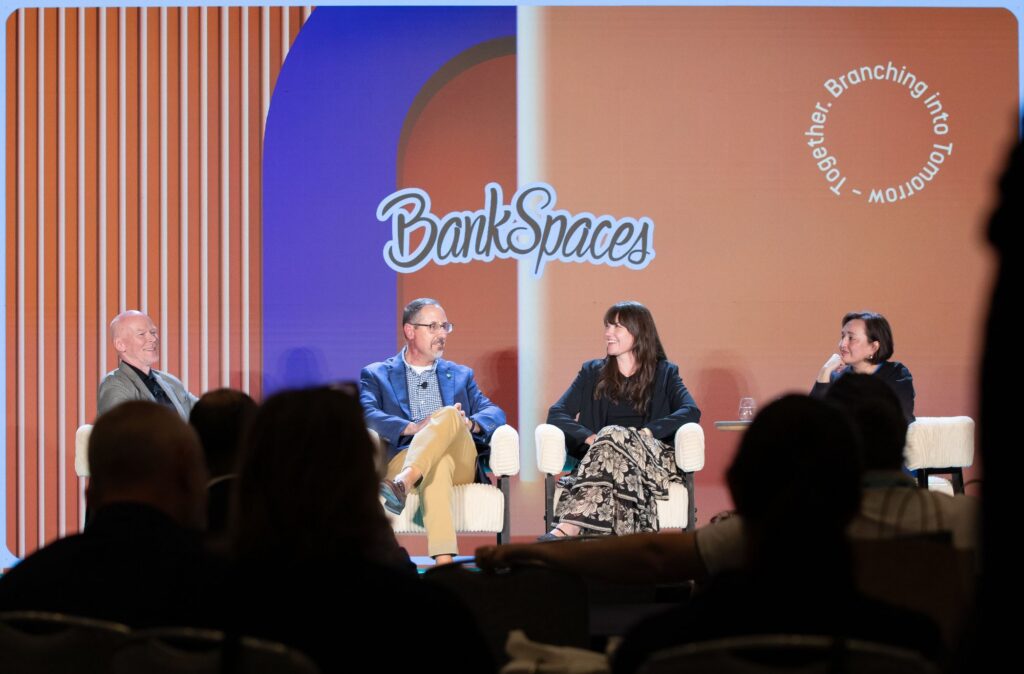
At the retreat, I was a panelist on “From beige to bespoke: Turning bank branches into luxury destinations,” where we pushed the conversation past what the branch should be, and toward how it should work. Because if branches are meant to deliver advice and build relationships, the current reality doesn’t support it.
That’s largely due to the fact that when people need financial guidance, banks are rarely their first call. They turn to friends, online communities, independent advisors, and increasingly AI—not because these sources are more accurate, but because they are generally trusted to have the right context and unbiased opinions. And that is where banks continue to struggle. Because what they define as advice lives in a narrow lane of big life moments tied to their own products (e.g., buying a house, needing a mortgage).
Today, most attempts to modernize the experience focus on the design of the environment, and there’s been real progress in reducing the barrier to entry. Bank of America’s Two Bryant Park, for example, uses lush plants, local artwork, and sculptural branding to bring the park indoors. It’s a stylish, welcoming place in which customers can complete traditional banking interactions.
Capital One Cafés invite people in for coffee, often with a discount tied to a credit card—a page out of retail’s playbook—and it’s effective as an entry point. When my office was in Union Square, I often used my husband’s card for a $2 coffee. But I never considered a banking conversation. I was there for the [coffee] transaction, and nothing in the experience shifted my frame of mind.
Even more experimental concepts haven’t cracked the code. “Cashless branch” models reduce or remove routine transactions in favor of advisory space and digital tools. On the surface, it signals progress toward relationship building over transactions. But in doing so, it cedes those contextual touchpoints to digital channels, leaving bankers without the cues that relationships are built on.
The cost of forgetting the customer
To design for today’s consumer mindset, we need to look at how we can design trust in ways that reflect how service is actually experienced. And how to do so becomes clearer when you look at what’s been lost.
A few years ago, my mother-in-law told me about her local branch being acquired. She had known her teller for years and relied on them for guidance in both small and significant financial moments. After the acquisition, that disappeared. She described it simply: she went from being somebody to nobody overnight. The space didn’t change, and neither did her financial habits, but the service did.
That loss reflects a broader shift: service used to build trust over time through accumulated understanding. A banker knew your history. A pharmacist understood your needs. A doctor didn’t require you to start from scratch at every visit. Interactions built on one another, reinforcing confidence with each exchange. To be clear, I understand this was a fragile and unscalable model, but industries have over-corrected in creating interchangeable systems where you can be helped anywhere, anytime. In theory, this ‘consistency’ is a good idea, but in practice it has resulted in anonymity.
Our Humanizing Brand Experience: Financial Services research puts a name to this. Among the Retail Loyalists segment, trust is defined not by product quality or digital capability, but by recognition. For this group, confidence in a financial institution comes from how well they’re remembered.
Stronger service models outside of banking show what trust looks like when it compounds rather than resets. At The Ritz-Carlton, guest preferences carry across properties globally, allowing service to build on history rather than restart. At Trader Joe’s, trust comes from a consistent service culture built on employees that truly love helping customers and giving advice, without formal personalization systems. At Nordstrom, it shows up through long-term styling relationships that deepen over time. And in Apple stores, recurring “Today at Apple” sessions extend value beyond transactions into intimate educational sessions with likeminded people. Across these examples, trust is not built in a moment, but accumulated.
Banks already hold the raw material for this and often do a pretty good job of delivering it in digital experience. Fintech disruptors, like Monarch, have pushed the digital experience even further by connecting all that data and offering advice and a big picture view on your finances. But this deep understanding rarely shows up in the human experience. When someone enters a branch or calls a service line, the interaction starts over.
The future of banking is context
So that is the opportunity. Not to redesign the branch as a space, but as part of a continuous service that carries context forward. That’s where technology, specifically AI, can play a fundamentally different role by making staff both more capable and more human, synthesizing financial history and surfacing what matters. It will eliminate the need to reconstruct the story each time and enable more meaningful guidance.
The next era of “smart banking” will not be better screens or more seamless interfaces, but systems that can remember. Until service carries context forward, what banks call a relationship will remain an illusion.

April 30, 2026 By Alison More
Related articles

Winning in direct-to-patient healthcare starts with brand

The algorithmic plateau: Why banking’s next advantage is brand