

Sensorial and behavioral branding: What you can learn from humanized models to drive ROI
What’s the ROI of smell? It sounds like a completely irrational question, but if you can’t answer it, you might be leaving money on the table.
Not because a nice smell will open wallets, but because the question itself forces you to face the reality that most of what drives customer decisions happens before anyone reads your carefully crafted copy or clicks your perfectly optimized CTA button.
Most brands are designing experiences as if that’s not the case.
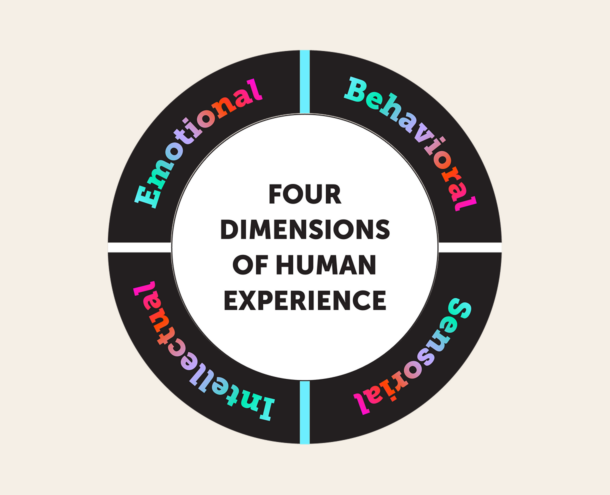
It turns out there are four dimensions to how humans experience brands, and most organizations are only working with two of them.
Why most brand experiences fall flat
Historically, brands focused their customer experience initiatives on two questions: “What do we want people to think about our brand?” and “How do we want people to feel about it?”
These questions represent the intellectual and emotional drivers of brand experience. And yes, brands have always cared about behavior too, but they’ve reduced it to a single macro-action: the purchase. Click “buy now.” Swipe your card. Sign the contract.
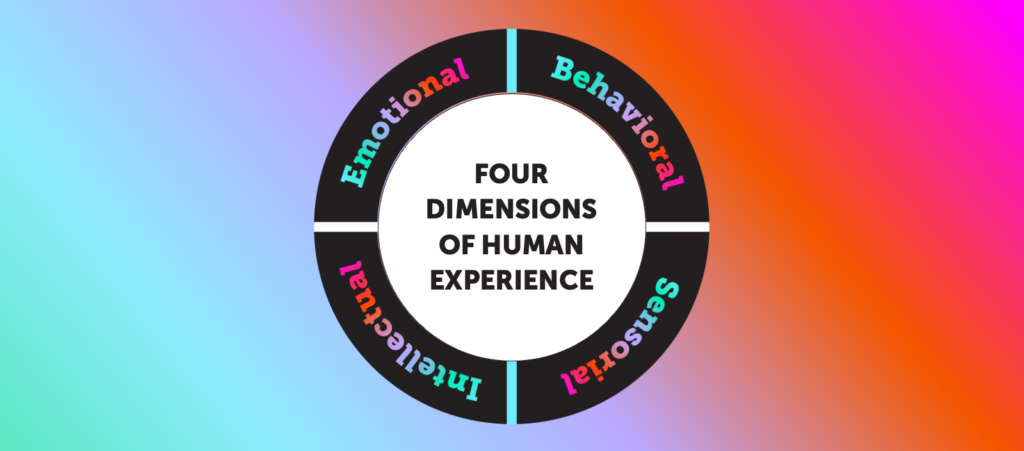
But for too long brands have failed to acknowledge the sensorial cues that shape perception before conscious thought, and the behavioral micro-moments that build attachment long before (and after) purchase. Thirty plus years of social and behavioral science research proves that humans don’t just think and feel. We sense and act. Monigle’s Humanizing Brand Experience research reveals that humans experience the world (and therefore brands as well) in four dimensions, not two.
When brands stop at intellectual and emotional experiences, neglecting sensorial and behavioral drivers, they’re working with half the picture. Which explains why so much marketing fails to connect.
Sensorial: The gateway to attention
Your brand speaks before it says a word. The sensorial dimension is how brands engage the five senses (visual, auditory, tactile, olfactory, and gustatory) and trigger visceral responses. Research shows sensory cues influence our thoughts and emotions before we’re consciously aware of them. Without strong sensorial groundwork, your intellectual messages and emotional stories reach people who haven’t been primed to receive them.
This works even in digital environments, where visual depictions trigger mental simulations of physical sensations, invoking responses that feel real to our brains. When used effectively, your brand can shape customer perception and kickstart the decision-making process before rational evaluation even begins. Just imagine the advantage over competition who’s only touting their product specs.
The sensorial dimension works across every touchpoint in subtle but strategic ways. Abercrombie architects complete sensory experiences with cologne scent, flattering lighting, curated music, and tactile shopping bags. Capital One reimagined branches as cafés with brewing coffee aromas, treating customers as whole people.
Apple’s unboxing experience (the box resistance, materials sliding apart, weight distribution) triggers dopamine responses. In-store tactile engagement creates quality associations that reinforce every subsequent interaction.
Even without physical touch, digital experiences can trigger sensory responses. Airbnb’s warm photography mentally simulates comfort before any messaging lands. Coca-Cola’s “Try Not to Hear This” campaign shows how visuals alone evoke taste and sound.
Sound builds instant recognition beyond the visual and physical world. Netflix’s “ta-dum” and Mastercard’s “da-da-da-dum” create familiarity and trust across contexts where logos and visuals can’t .
The environment doesn’t just frame the experience, it actually changes how we sense within it. Research on coffee consumption demonstrates that the multi-sensory atmosphere (lighting, music, ambient temperature, background aromas) directly influences flavor perception and hedonic ratings.
A café with warm lighting, curated soundscapes, and the right ambient scent doesn’t just make coffee feel better, it makes coffee taste better. The sensorial environment primes our brains before the first sip, shaping what we perceive and how much we’re willing to pay for it.
Then there’s social sensing, the oft-forgotten sensorial aspect. Am I seeing others use your brand? Am I seeing people I consider respectable, people I’m close to, people I want to be like? Think about it. Would you be more likely to try a new restaurant because it advertises as being the best spot in town, or because you saw a long line of people outside of the restaurant, signaling its popularity?
Without strong sensorial groundwork, your messages reach people that haven’t been primed to receive them. You’re asking for rational consideration before you’ve earned sensory attention. But our brains use sensory input to decide what’s worth paying attention to in the first place. That’s why sensorial isn’t decoration, it’s the gateway that determines what actually gets through.
Behavioral: Action creates attachment
This goes far beyond “click here” thinking. Of course, the most desired behavior for all brands is for consumers to become customers, but the pathway to purchase is laced with many engagements that lead the horse to water.
Yet marketers consistently overlook this. We fixate on the macro-behavior (the purchase) while ignoring the constellation of micro-behaviors that make it possible. We optimize checkout flows but neglect the small acts of participation that build affinity along the way: configuring a preference, saving an item, sharing a link, rating an experience, joining a waitlist, customizing a dashboard.
These are the moments where customers signal investment, create personal stakes, and begin to see themselves in relation with your brand. When we design only for the transaction, we skip the participation that makes the transaction feel earned for the consumer rather than extracted.
When people act, they create cognitive commitment. Each action they take becomes evidence they use to understand their own preferences and identity. This creates behavioral momentum where that first small action makes the second more likely, then the third, and so on, all the way to the credit card.
In other words, an object in motion stays in motion. The same is true for brands.
At IKEA, customers assemble their own furniture. This hands-on participation creates psychological ownership. The effort invested makes the product feel more valuable and the relationship more personal. In fact, this phenomenon has become so well documented that it has been given its own term: the IKEA effect.
Duolingo’s daily streak mechanics and achievement badges turn language learning into behavioral ritual. Users build habits, compete with friends, and track visible progress. Each interaction deepens commitment to both the goal and the platform.
LEGO transforms customers into co-creators through building. Every set requires hands-on assembly, turning passive consumers into active participants. This behavioral engagement creates deep psychological ownership and justifies premium pricing that competitors can’t touch. When the experience creates the value, customers don’t blink at paying $70 for a few pieces of plastic.
Sephora’s Beauty Insider program invites customers to review products, share photos, and earn points through engagement. Each review is an investment in the community and the customer’s own expertise. And, REI’s Co-op membership program transforms shoppers into stakeholders who vote on company decisions and receive annual dividends. When customers take action with your brand, they’re co-creating the relationship rather than observing it from the outside.
Then there’s the behavioral dimension in everyday interactions. Are you making it easy for customers to take the next step? Are you removing friction or adding it? Consider how Amazon’s one-click ordering or Spotify’s seamless playlist creation removes barriers between impulse and action.
Without behavioral engagement, your brand remains something people think about rather than something they do. You’re building awareness without momentum. But humans judge their own inclinations, and in turn make decisions about them, by observing their own behavior. When customers act with your brand, they create their own proof of the relationship. People believe what they do far more than what they’re told.
Integration over isolation
The gap between understanding humans and designing for them cripples more brands than external market forces. Some brands develop deep human insights that never leave the strategy deck. Beautiful frameworks, compelling research, profound understanding of what makes people tick, but no clear path to implementation. These brands know what humans need but struggle to operationalize that knowledge into tangible experiences.
Others excel at execution without grounding. They move fast, implement efficiently, and deliver polished touchpoints across every channel. But without understanding the human psychology driving those decisions, the work feels disconnected. It gets things done without moving the needle. It fills channels without creating connection.
Human understanding paired with tactical execution across sensorial, emotional, intellectual, and behavioral touchpoints is the bridge most brands never build.
Brand experiences are living systems, not linear processes. Each dimension manifests through specific, strategic engagements. A retail environment might emphasize sensorial elements (lighting, texture, sound) to trigger emotional responses that shape intellectual perception and drive behavioral outcomes. A digital product might prioritize intellectual clarity and behavioral ease while using subtle sensorial cues to build emotional trust.
These touchpoints are interdependent. Pull one lever and you create ripple effects across the system. Change your visual identity and you’re not just affecting what people see (sensorial), you’re influencing how they feel about you (emotional), what they think your brand stands for (intellectual), and whether they’re willing to engage (behavioral).
Strategic orchestration means making deliberate choices about which levers matter most for your audience and business goals. Not everything needs equal weight. A healthcare brand might lean heavily into emotional connection and behavioral guidance while a fintech startup prioritizes intellectual clarity and behavioral ease. The key is ensuring your tactical decisions across all four dimensions work together, not against each other.
Without this orchestration, even strong individual elements create friction. If your brand messaging promises warmth and personal connection (emotional), but your customer service scripts are robotic and transactional (behavioral), you’ve created friction in the system. If your visual identity signals premium (sensorial) while your product feels cheap and low quality when people interact with it (behavioral), the disconnect undermines both.
When orchestration works, the dimensions amplify each other. A luxury hotel might use subtle signature scents and curated ambient sound (sensorial) to create a sense of escape and status (emotional), making their premium pricing feel justified (intellectual) and encouraging guests to book spa treatments or drive guests to share their experience on their socials (behavioral).
A productivity app might combine satisfying micro-interactions and progress visualizations (sensorial/behavioral) that generate feelings of accomplishment (emotional), reinforcing the belief that the tool actually makes you more effective (intellectual). The dimensions don’t just coexist, they compound.
Liquid Death’s aggressive skull branding and tallboy cans (sensorial) subvert expectations for water, creating irreverent, rebellious feelings (emotional) that reframe hydration as counterculture (intellectual). This encourages consumption at social events and music venues (behavioral). The sensorial shock value drives behavioral virality, which reinforces emotional identity, which validates the absurd intellectual premise of “murder your thirst.”
Notion’s clean, endlessly customizable interface (sensorial/behavioral) creates a sense of control and freedom (emotional) that makes users believe they can build their perfect productivity system (intellectual). But the integration runs deeper: the behavioral act of customizing templates generates emotional investment, which makes the intellectual promise of “all-in-one workspace” feel personally true. Users become advocates (behavioral) not despite the learning curve but because of it. This is a great example of where purposeful friction can actually increase engagement.
The goal isn’t perfection across all dimensions simultaneously. It’s intelligent integration and prioritization. Understanding where human psychology meets tactical reality, then making strategic choices about which experiential touchpoints to activate (and in what sequence), will create the outcomes your business needs.
This prevents “random acts of branding” where touchpoints proliferate without coherence. Instead, every sensorial choice, emotional beat, intellectual message, and behavioral prompt becomes part of a larger system, working together to move people in meaningful ways.
The data beyond intuition
Through structural equation modeling, we’ve demonstrated that these four dimensions, when properly activated, can predict consumer behavior with over 75% accuracy. We can map which specific combinations of sensorial, emotional, intellectual, and behavioral touchpoints drive specific outcomes, from purchase intent to brand loyalty to advocacy.
This transforms questions like “What’s the ROI of that brand smell?” or “Should I invest in this key moment versus that campaign?” from intuition into evidence. We can prove that, for example, dialing up one sensorial element while adjusting two emotional touchpoints will shift purchase intent by specific percentage points. Or that improving three behavioral drivers without addressing one intellectual barrier will underperform.
The model reveals the precise combinations that drive outcomes, the thresholds where incremental investment stops generating returns, and the interdependencies where changes in one dimension amplify or diminish others.
Experience design for humans
Research validates what experience designers have long intuited: humans process brand experiences holistically, not sequentially. We don’t separate what we see from how we feel from what we think from what we do. We integrate it all, instantaneously, often unconsciously.
The four dimensions provide a framework to design for that reality. To move beyond best practices and generic tactics toward strategic experiences that connect with how humans actually work. To predict, with measurable confidence, which combinations of sensorial, emotional, intellectual, and behavioral elements will drive the outcomes your brand needs.
That’s the power of putting social science at the center of brand building. Not just understanding humans better, but using that understanding to create experiences that genuinely move them.

April 7, 2026 By Grant Mason
Related articles