

Race to the bottom: How billion-dollar sports teams are shipping dollars down the drain
Part 1: Culture design
A three part series on overcoming the barriers to delivering in the transformation economy within sports.

For so many people, the world of sports is the dream. But the reality is far from a dream come true. For every Lakers and Inter Miami, there are hundreds of teams and leagues struggling as entertainment dollars shift and disappear. Once you step behind the scenes, it becomes abundantly clear why so many teams, organizations, and their people are so utterly unprepared to thrive in the new entertainment landscape. After all, in the transformation economy, sports teams don’t win by entertaining fans, they win by shaping who fans become.
The transformation economy has arrived
Let’s first define the world as it will be. B. Joseph Pine clearly outlined where we are going in his book The Experience Economy. Traditional business has operated in a transactional “service economy,” where services are provided for a fee. However, organizations are now shifting into the “experience economy.”
Think Disney Parks, where character interactions, shows, and rides allow consumers to immerse themselves into a world different from their own. We will soon be (and in many cases already are) in the midst of a further economic shift where consumers will allocate and spend dollars with brands and organizations that go beyond providing an experience and actually guide and facilitate an internal identity change, in which the consumer leaves a different person than who they were when the experience began, and adopts these changes across their life.
Noom goes beyond diet plans to instill behavioral change through coaching. Masterclass not only provides expertise but makes one a more capable individual. For sports, teams can create a whole-hearted sense of achievement by fostering personal growth in their fans. That betterment comes in the form of physical aspiration, a sense of belonging, pride, sense of self, and more.
Unfortunately, so many sports teams have yet to even scratch the surface of the experience economy, and remain stuck in the transactional service economy. But we know that sports can facilitate transformation within the lives of fans. Sports are episodic, providing a place for consistent engagement. In most cases, teams have full control over the experience within their home facilities. Teams can leverage personnel, navigation, activities, and atmosphere to guide transformation. But having the tools isn’t enough. To reach the experience economy and eventually deliver transformation, teams must focus on three imperatives: culture design, partnership ecosystem, and experience design.
The hidden cost of a broken culture
In part 1 of this series, we’re starting with an examination of the culture design side of the equation. Like a star player hiding an injury, the damage starts under the surface. The research shows that a culture in critical care causes direct business harm. But let’s put some numbers behind it. Replacing a departing employee costs 50-200% of the annual salary in recruiting, onboarding, and lost productivity.
Culture can drive improvements in productivity up to 18%. Just looking at a mid-tier team, with an annual revenue of $328M, culture alone could drive $4.5M in financial impact. Generating an equivalent $4.5M in profit through new revenue would require approximately $22.5M in sales, assuming a typical NBA, NFL, or NHL industry margin of 20%. Culture delivers this impact without requiring additional sales staff, capital investment, or marketing budget.
And, because sports organizations sell lived experiences, not just products, culture doesn’t just reduce overhead. It directly shapes the quality, consistency, and credibility of what fans feel. While it seems silly to ignore culture, there are three fundamental cultural errors that we have seen sports teams, owners, and management make time and time again: they don’t enable their people, they fail to empower their people, and finally, they neglect to transform them.
People enablement builds capacity for change
Let’s first talk people enablement. Enabling people to act within the organization requires a culture designed to support change and learning. In sports (as with many other industries), complacency is the enemy of progress. Sports teams tend to hire from within their own ranks, creating stagnant cultures where ‘business as usual’ becomes the default.
We have seen sales teams that sit idle at a table while pick-up games play on around the corner. We have seen partnership teams that want to bring in a local regional player for a few thousand dollars more over a globally recognized brand. We have seen internal teams who can’t identify the markets that they want to reach in research.
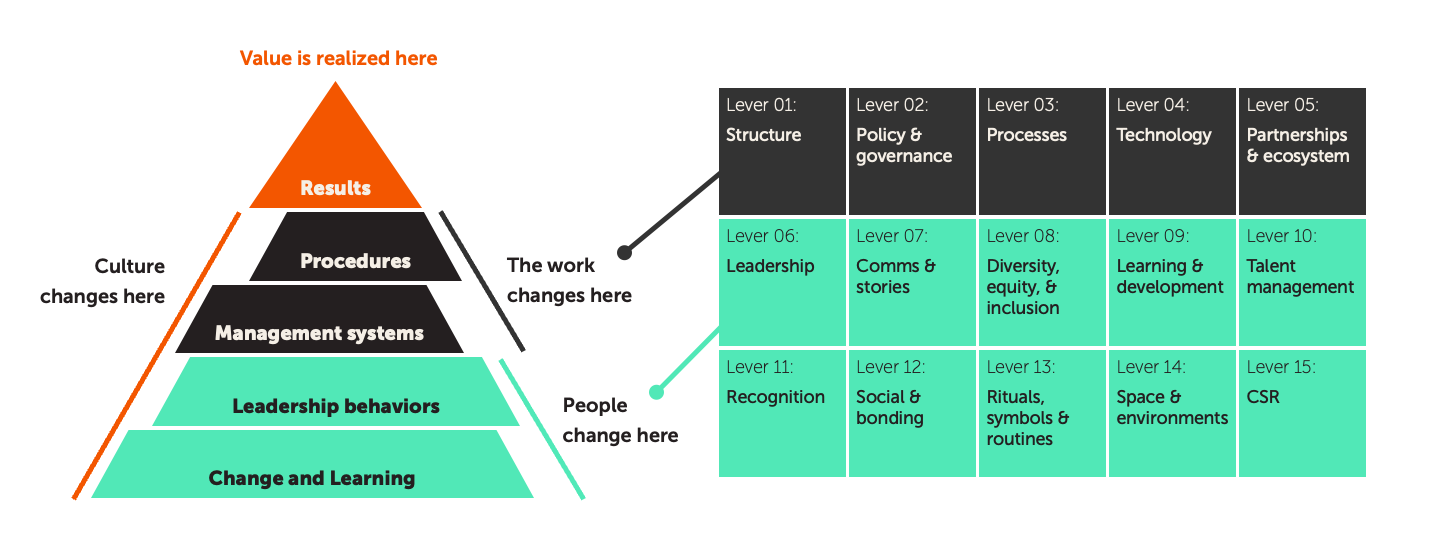
All of these are symptoms of a culture that deprioritizes change and learning, yet organizations can control specific levers to drive both. These levers range from how teams are incentivized to how cross-functional collaboration is structured, and everything in between. The consistent challenge that we see organizations struggle with (especially in sports) is the inability to view these levers as a unified system. They silo sales teams’ incentivization from community engagement’s events and fail to connect either to shifting market perceptions.
People enablement means putting an emphasis on developing individuals consistently in their expertise, their cross-functional awareness, their openness to new ideas, and their ability to understand how to operationalize change. But change and learning is only the first layer in building a culture that drives business outcomes. On top of it lives the leadership behaviors.
Empower your people through your leaders
Picture a boardroom. Employees evaluate how to reinvigorate the team as they face competition from other leagues, a new team entering the city, and declining fan engagement. Meanwhile, there sits the billion-dollar ownership executive who actually decides the fate of the team, scrolling social media on his iPad. The foundation that change and learning establishes in enabling people to activate and deliver in their roles goes nowhere without leadership behaviors to empower people. Apathy, pessimism, or misaligned visions from leadership undermine enabled personnel by failing to empower them.
Gone are the days of leaders simply managing operations. Now they are leading a community where transparency, accountability, access, and cultural scrutiny all live at the forefront of perception. They connect purpose to productivity and impact. Leaders need to shift from storytelling to experience to build capabilities for next-gen growth. And these behaviors manifest as empowerment in a variety of forms: resources, expertise, and enthusiasm.
Different teams require differing forms of empowering investment. For young and small teams, the priority is expertise and guidance. These groups bring enthusiasm and resourcefulness but lack the experience to navigate the political, financial, and bureaucratic barriers that drive organizational success.
Then there are established but stagnating teams. Their needs are two-fold: resources and motivation. Resources can come from Change and Learning processes that upskill employees, or from additional personnel, budget, and partners. Motivation is a product of leaders acting as cultural stewards through concrete and definitive actions. It goes beyond getting off the iPad and listening in the room. True cultural stewardship means acting on what you hear. We have seen organizations rapidly drain talent after leaders listened to research, then disregarded it to pursue their own vision.
Conversely, we have also seen leaders expect autonomy from their people, only for their people to fail to act. Without clear behavioral expectations and leadership by example, employees don’t know what empowered action looks like, so they default to inaction rather than risk making the wrong move. Leadership behaviors require two-way accountability. Too often, the lack of concrete behavioral expectations allows ego and apathy to override outcomes.
Strong leadership means creating clarity around decision rights so teams know when they have autonomy and when they need alignment. It means establishing shared metrics that connect individual work to organizational outcomes. It means modeling the behavior you expect, admitting when you’re wrong, and celebrating teams who take calculated risks even when they don’t pan out. When leaders define what empowered action looks like and hold themselves to the same standards, teams can execute with confidence.
Transform your people through systems that stick
The final step to internal culture change is facilitating transformation via management systems and procedures. If people enablement accounts for capabilities, and people empowerment accounts for permission and support, then people transformation delivers permanence. This is where most teams fail. Not because they lack vision, but because they mistake inspiration for change. Posters fade. Town halls end. Transformation requires embedding new behaviors into the systems that govern how work actually gets done.
For too long, management systems have quietly been optimized for just one thing: protecting legacy operations. The same structures that created dynasties now block evolution, a fatal flaw in the transformation economy. Today, most teams are structured around functions, not outcomes. Personnel capabilities notwithstanding, this fragmented structure does nothing to complete a holistic fan journey. In order to codify internal capabilities to deliver a transformative experience for fans, it requires a cross-functional internal system that mirrors the desired experience.
Transformation requires experimentation, which means risk. So, if the organization is looking to drive transformation via culture, it requires a structure that clearly defines what risks are allowed. Too many approval layers, unclear decision rights, and legacy governance models slow down innovation. When every new idea requires navigating this maze, innovation dies not due to resistance but from exhaustion. Designing a structure that supports guided risk requires decision velocity as a performance metric, distinguishing between brand risk and organizational discomfort, and empowering employees with clear authority to make decisions within defined parameters.
Working hand-in-hand across departments within a sports league, we saw first-hand a culture characterized by reactivity. Sales, research, fan experience, and business development each exhibited sub-cultures that blocked evolution at both the individual and organizational level.
So, if accountability and collaboration are challenges for the organization, design a structure that navigates these. The ideal structure connects your KPIs, team roles, communicational channels, and operational processes so everyone works towards the same goals. Having a shared single source of truth (built both with tech stack and reporting lines) to house these elements allows the enablement of intrinsic collaboration and shared accountability. Ultimately, this structural transformation empowers people to apply their expertise.
From transaction to transformation
At the end of the day, sports ownership is an investment. Just like stocks, or real estate, ownership groups want to see a return. But approaching sports ownership as nothing more than something to profit off of results in a transactional relationship, not just with fans, but with internal team members. To quote Rebecca Welton from the perennially positive Ted Lasso, “Just because we own these teams doesn’t mean they belong to us.” If you want to wring dollars out of a rapidly drying rag, be transactional. But if you want to grow a money tree, if you actually want to see return on investment, it requires being intentional. Intentionality facilitates a wholehearted transformation for the people within an organization that drives real results.
Culture is the first step to existing in a transformation economy. As Michael Jackson said, “If you want to make the world a better place, take a look at yourself and then make that change.” It’s time for sports to get off the bench and examine culture as a core competency. Otherwise, the best talent will walk, metrics will continue to decline, and fans will continue to decry the experience.
To be truly equipped for the future, deliver on transformation for your people so that they in turn transform your fans. If you want to fight competition, you create differentiation in cultural teams that are empowered to activate experience. If you want to increase market recognition, build a culture of authenticity that drives customer preferences through aligned partnerships, unified incentives, and seamless systems. And if you want to retain the best talent, leverage culture to turn talent into a population of continually progressing, passionate people. Delivering transformative experiences requires an organization prepared to function outside of the box. After all, Curry didn’t change the game overnight.

February 5, 2026 By Hayes MacGregor
Related articles
Sensorial and behavioral branding: What you can learn from humanized models to drive ROI